Do you want to be the kind of leader people never forget? This week in a first-of-its-kind react-style Maxwell Leadership Podcast episode, John Maxwell sits down with Jeff Henderson to share the essential skills that turn everyday leadership into a lasting legacy. As John teaches, Mark Cole provides practical strategies to help you activate John’s teachings and elevate your impact right now.
Our BONUS resource for this episode is the Learn These Skills to Become a Memorable Leader Worksheet, which includes fill-in-the-blank notes from John’s teaching. You can download the worksheet by clicking “Download the Bonus Resource” below.
Leaders, stop trying to do it all yourself. The best leaders know their limits, operate out of their strengths, and set others up for success. Find freedom with BELAY — pairing you with vetted U.S. virtual assistants so you can focus on what matters.
To help you get started, BELAY is offering Maxwell Leadership listeners a free download of their resource, The Difficult Conversation Playbook. Just text MAXWELL to 55123 for FREE access.
Belay ad:
You know what’s costing your team more than any bad hire or missed deadline? The conversation you keep putting off. Most leaders avoid hard feedback because they think they’re protecting people. But silence doesn’t protect your team. It confuses them. It tells them that falling short is fine and over time, that slowly erodes everything you’ve worked to build. The best leaders know that clarity is a gift. Specific, honest, timely feedback builds trust, raises standards, and unlocks real growth in your people. Belay’s free resource, the Difficult Conversations Playbook gives you a step by step guide to delivering hard feedback without damaging relationships.
Belay ad:
So you can lead with confidence and stop dreading the conversations that matter most. Text Maxwell that’s M A X W EE L L to 55123 to grab your free copy today,
John Maxwell:
you have to get over yourself. Your nerves. Everything that bothers you about speaking is because you’re thinking of you more than you are of the people. And you got to get over yourself. And I tell people they should. Every one of you. You need to get over yourself. I tell people all the time, laugh at yourself because everyone else is.
John Maxwell:
And I watch people take themselves way too serious.
Mark Cole:
Welcome to the Maxwell Leadership Podcast. I am excited now. I’m excited every podcast. I truly love doing the Maxwell podcast. I’m excited today because I always love new. And today, for the first time ever, we’re doing a podcast that is unusual, it is unique. Now let me say this. There is a difference when you read a book and you mark it and when you read a book and it marks you.
Mark Cole:
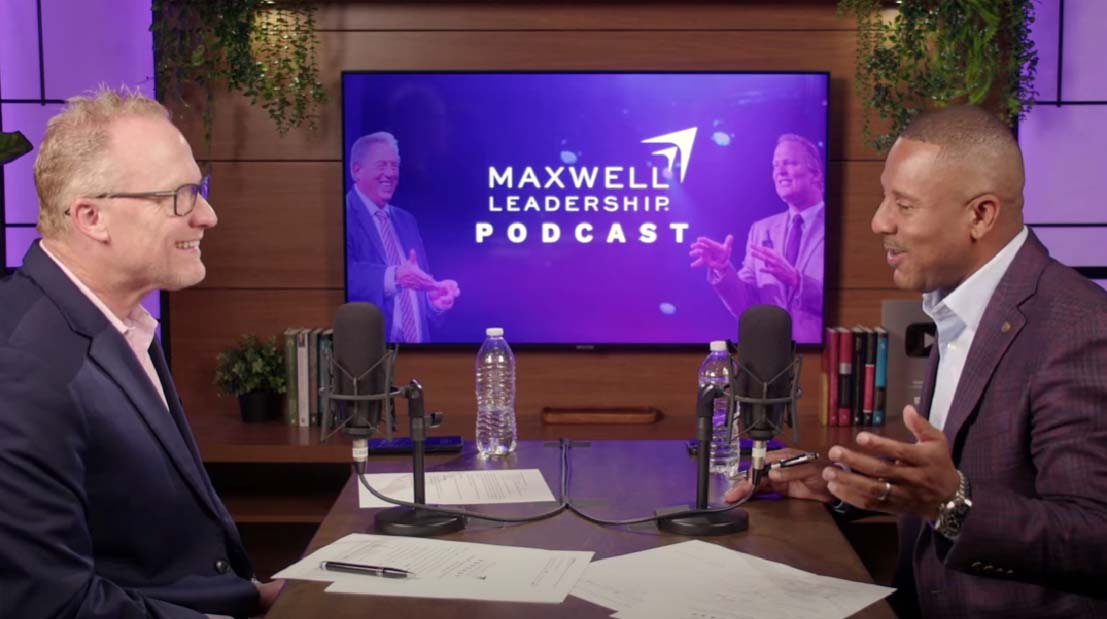
Recently, John Maxwell sat down with Jeff Henderson. Jeff Henderson is a Maxwell leadership thought leader. He’s also an executive at Chick Fil? A. And we were at Chick Fil? A in front of Chick Fil? A headquarters, world headquarters. And Jeff Henderson brought John Maxwell to the stage and had a stack of John Maxwell books. He pulled out six of those books and told John Maxwell how the book marked him and then asked John what he thought about the point when he wrote it of what had marked Jeff Henderson. It was so incredibly insightful, not only in the content, but how to let a book mark you that. I decided I wanted to make it available to you today on the Maxwell Leadership Podcast.
Mark Cole:
Those of you that don’t normally watch the podcast, you. You want to go over to YouTube and watch this one because it’s Jeff and John sitting down together and walking through six books that has marked Jeff Henderson and why John Maxwell wrote those books and why he wrote that comment that impacted Jeff. It’s incredibly Insightful. So today you always want to go to YouTube, but today you really want to go to YouTube and watch John Maxwell. Hey, by the way, you can get to the YouTube link, you can get other show notes and you can get the link to download a bonus resource to walk through this with Jeff. With John Maxwell, you go to MaxwellPodcast.com/Memorable. Now I’ll come back after each book and just give you an application point of what I applied and what I want you to apply to these excerpts. Here we go.
Mark Cole:
Grab a pen, grab a paper, click the link. See you on YouTube. Here is John Maxwell. Jeff Henderson.
Jeff Henderson:
When people ask me what’s a leadership book to recommend? This is the classic 21 irrefutable laws of leadership. Here’s one of the highlights in Law of empowerment. To lead others well, we must help them to reach their potential. That means being on their side, encouraging them, sharing the power we have with them and helping them succeed. Great leaders gain authority by giving it away. Tell us about that.
John Maxwell:
I really believe that very strongly. I think insecure leaders never empower people because they’re afraid what happens if they do a better job than me or what will happen to me. And if you have insecurity and you have a scarcity mindset which go together quite often, it can be a real problem. And in my earlier days, I didn’t have a scarcity issue and I didn’t have an insecurity issue, but I had a, I want to hold onto this issue until I get it good. And then I want to sit down with my team and say, here’s what I’m thinking. And they go, we are not worthy. We are not, you know, and here I am.
John Maxwell:
My gosh, that was amazing. What? Woohoo. I’m a great leader. And it was a real breakthrough for me, Jeff, when I realized no matter how good I was or no matter how I worked an idea or a thought, that the moment that I sat down at a table with other good people and shared with them the idea that they could make that idea better, and I’m passionate about shared thinking and sustained thinking. I think if you can sustain thoughts and then if you can share that thought. I’ve done this hundreds of times where I’ve gone to the team and say, here’s what I’m thinking, and I lay out my best thinking, maybe I’ve been thinking about it for a couple weeks and literally, I promise you, within two minutes somebody comes up with something better than what I laid out there. And they always improve me. And all These books.
John Maxwell:
These books. I mean, some people think I thought all these thoughts, and no, I thought some of the thoughts, but some of the best thoughts in my books were given to me by other people, and I’m very grateful to them. I think that security means that you not only value the people around you, but you value what they can contribute. And we’re just better together. I don’t think it’s possible if you’re with really good people, to give them an idea or thought and have them not improve it. So I think what I would say to anyone is, you’re better together than you are, seeing one is too small of a number to achieve greatness. And I think that’s true. And so I greatly value.
John Maxwell:
I mean, Jeff, you’re one. Jeff, you’re one of the best thought leaders I know. You’re a wonderful thinker, and you’re a great thought leader. You know, when we. I tried to grab something a little bit to eat, and I said, jeff, sit down here with me. Come on, talk to me. Tell me what you’re learning. You know, I could hardly wait to steal something from him that I can put in my book.
John Maxwell:
You know what I’m saying? But I know this. If I had. But If I had 15 minutes with you, I wouldn’t waste it. I wouldn’t waste it. I watch people waste time, all the time in conversations, and I want to say, is that going to improve anybody’s life? Is that going to really make anybody better or different? And I would sit down with you and I’d try to find out what your strength is as quick as I could. And then I would ask you to teach me out of that strength. And trust me, every one of you could make me a better person today if I just had time to be with you. And I think when you have that perspective, I think it just opens up your world to a better world.
Mark Cole:
Okay, I gotta stop right here before we go on, because first of all, what John just said about Jeff Henderson being a thought leader, I completely agree. In fact, this morning, this morning, the day that I am recording this podcast, I had breakfast with Jeff Henderson. And what I can say about Jeff Henderson and John Maxwell, they are constantly learning so they can improve their thinking, so they can lead with thought. Catch that. They are constantly catching learning. They’re constantly going after learning. It improves their thinking. And then they become that thought leader that John Maxwell just said about Jeff Henderson.
Mark Cole:
That doesn’t happen just because there’s great thoughts in them. That happens because of what they put in them, how they process what they put in, and then their willingness and desire to put it out there for others. Really, what I pick up from them as they’re talking about 21 laws of leadership is they make the most of learning moments. They have got a discipline that says, if I’m given a moment to learn something, I’m going to take it, I’m going to make the most of it, and I’m going to make a difference with the people around me. See, I think the greatest limiting factor in someone’s leadership is when they don’t take time to take advantage of opportunity. To the person who’s given much, much is required. To those of us that have access to this podcast, for instance, there is something required of us every time that we get it. See, when John wrote the 21 laws, he made a decision.
Mark Cole:
I am going to give people disciplines in leadership that when practiced, when pursued, when applied, it will make a big difference in their leadership. And so Jeff and John are giving us something today that will absolutely make the most of this podcast. In fact, it’ll make it memorable. That’s what we’re talking about today. We’re talking about learning skills to become a memorable leader. Are you ready to make the most? Are you ready to become memorable? Here they are. Here’s John and Jeff.
Jeff Henderson:
We have a leadership principle here called Think Others first. And you talk about it from a perspective of adding value to people. That’s why one of my favorite books is 25 Ways to Win with Beautiful People. I want you to talk about this. One of the chapters here is Create a Memory, and visit it often. Why is creating a memory for teams and others such a powerful leadership strategy from your perspective?
John Maxwell:
Because it includes them. The memory includes them. I can have. You can give me a gift. It doesn’t include you, but the moment you and I do something together, there’s something now that we have relationally that we can connect with. And I think then what I work on hard is really making the memory a better memory. You know, in other words, how can I take something that’s good and make it better? And I’m always, you know, every year, my wife Margaret and I, we give our children and grandchildren for Christmas. We give them trips.
John Maxwell:
We don’t, you know, you know, buy stuff, they lose it, they break it, whatever, but we just do trips. I just took my daughter and her husband and like, some of my grandchildren, Margaret and I just took them to the British Virgin Islands just for five days. They love the water, so we did a lot of water stuff. But every day from 9 to 10:15, we sat down and my newest book is how to Get a Return on Failure. And we did lessons every day on how do you get a return on failure? And we talked about it, and it just. It’s a memory. And so when I’m done, when we were flying back and what was your favorite thing? And I mean, we did a lot of favorite things there because it’s a great place. I mean, every one of them said our favorite thing was doing the book together.
John Maxwell:
But I think if you put it in a setting, it’s kind of like they know when we get ready for a trip, that’s going to be a better memory because we’re not only going to do a lot of wonderful stuff, but we’re going to grow together as a family.
Jeff Henderson:
That’s great.
Mark Cole:
All right. I had to jump in right here. Did you catch that? John did this with his family. He took a book and didn’t make it just available for shelf or another leader. He made it available for his family. He took time in their family vacation and dug into a memory that they say to this day was the best moments of all of these incredible opportunities and experiences they had on that vacation. Here’s why leaders make things better. They always do.
Mark Cole:
John says it often like this. He says leaders see more and before. And I believe that. I believe leaders see more than others see. They see before others see. I think leaders make things better than when they found them. I think that’s a leadership trait. And what John was illustrating right here, that I want us to catch right here in this podcast, to be a memorable leader, you gotta be memorable everywhere you go.
Mark Cole:
You can’t hang your leadership up on a nail when you get home and just say, well, I led all day. I’m wore out. You gotta walk into the house to be a leader. You can’t lead when you’re not on vacation. You gotta lead when you’re on vacation, too. You’ve got to find a way to lead and make people better wherever you are. We’re talking about 25 ways to win with people, and John just gave us a way to win with our family. Create memorable moments when you’re at home, just like you create memorable moments when you’re at work.
Mark Cole:
I’ve watched a lot of people wait until they have a position to lead. What John and Jeff are sharing with us right here is you don’t need a position and you don’t need a title, and you don’t need a work environment to Lead. You just need to take responsibility to make people better no matter where you are. And that’s how you win with people. Thanks, John. Thanks, Jeff. Alright, podcasts, let’s go. Are you loving this? Lean in.
Mark Cole:
Here comes the next book. Jeff picks up 16 laws of communication.
Jeff Henderson:
Let’s talk about 16 undeniable laws of communication. Because a principle of leadership is. Leadership eventually comes with a microphone, either literally or figuratively. You’re going to have to say, here’s where we’re going, here’s the vision. Fantastic principles here. You have three questions here in the law of content. How. And these are the questions.
Jeff Henderson:
How is what I’m communicating affected me? How can I make it unique and different? How can I make it better? I’d like to lean into that first one. How is what I’m communicating affected me? If not, if I’m not moved, my audience won’t be either. Tell us about that and how you’ve learned to become a better communicator over the years.
John Maxwell:
I love to teach communication. I think the ability to connect and communicate with people is probably the most important tool a leader can have. And when I was in my 20s, probably 25 or 26, I one day awakened to the fact that whatever I’m teaching won’t have a profound effect on others unless it’s, first of all, had a profound effect on me. And so the greatest message I ever teach is a message I live. And when I was probably 25, 26, I made a very important decision and that was very simple. If I don’t live it, I don’t teach it. And what that meant was there were a lot of things I didn’t teach and there are still a lot of things I don’t teach today because it’s not my life. I mean, I teach what I live and there’s, that’s our.
John Maxwell:
I think. I don’t think people want a perfect leader, but I do think they want an authentic leader. And what that means is that if you read something in my books or you hear me teach whatever it’s going to be, I do it. And to me, if I can lead me well, I can lead you well. And if I can be affected in a positive way, you could be affected in a positive way too. So if the lesson doesn’t move me, why would it move you? And if it hasn’t changed me, why would I expect it to change you? If it hasn’t helped me, why would I expect it to help you? So I think it all, I think all great communication begins With I sit down. It’s like somebody asked me one time, Jeff, they said, well, what’s your greatest leadership challenge? I said, well, that’s very simple. Leading me, that’s the greatest leadership challenge.
John Maxwell:
I mean, I can teach you what to do, but when you have to live it yourself, you have to go do it. But it’s out of doing it. Here’s what I know. Once you live it, once you do it, once you embrace it, once it changes your life, it gives you a moral authority that rises above regular communication.
Jeff Henderson:
Do you ever get nervous speaking? And for those who do get nervous speaking for a friend, what would you tell us about getting. Dealing with nerves?
John Maxwell:
When people ask me, how do you become a great communicator? It’s very simple. You have to get over yourself. Your nerves. Everything that bothers you about speaking is because you’re thinking of you more than you are of the people. And you gotta get over yourself. And I tell people they should, every one of you, you need to get over yourself. I tell people all the time, laugh at yourself, because everyone else is. And I watch people take themselves way too serious.
John Maxwell:
It’s like the person said to her, what will they all be thinking? I said, they’re not thinking of you at all. I mean, where did you ever get such delusional thinking in your own life that people and so just get over yourself? In fact, I wrote a. I’ve written some songs that go with some of my books. I go to Nashville, they give me these number one hit writers. We get in the studio. It’s a lot of fun. I mean, they’re the writers, they’re the good. So.
John Maxwell:
But they use my book ideas and I wrote a song, and you get it all however you get music. Again, I don’t even know. See, I don’t even know how you know how to get music anyway. But it’s called Get Over Yourself, and I love it because I’ve got to find myself to know myself. I’ve got to know myself to improve myself. I got to improve myself so I can get over myself, so I can give myself to you. You can’t give yourself to people if it’s about you. And my name is John and I’m your friend, you’re not that important.
John Maxwell:
The people. It’s all about the people. And the moment that you cross that line and you get over yourself, and you now are. Now you can freely give yourself to people and you can be real and you can. And you can really help them. But you know, again, who’s the hardest person to lead me. Once I can get through that, I can help lead other people, too.
Mark Cole:
All right, I had to jump in here. Cause John says you know how to get music. He doesn’t know words like Spotify, Apple music, but wherever you get music. Let me just say this. You wanna go check out the four songs we’ve released on John Maxwell? They’re really good. You’ll enjoy them, but you’ll see and hear his books and in every lyric, in every word. So do that. But here’s what I wanted to interject right here.
Mark Cole:
As we’re talking about laws of communication, John says this statement, and I gotta underscore it right here, right now in this podcast. You can’t give yourself to people if it’s about you and it’s all about your agenda. You have crossed the line from motivation to manipulation, and that’s what you don’t want. I can remember talking about communication. I can remember when John began to push me on his stages to communicate. I didn’t want to communicate. I was fine running companies. But he said, mark, we’ve got to build believability through your stage communication.
Mark Cole:
And I got to be honest with you, it was hard. It wasn’t just hard on the people that had to listen to me speak. After listening to John, that’s quite the jump. But it was hard on me because I constantly felt like I had to impress them, like I was having to live up to John. And I can remember the day that I got better now. It wasn’t that I got better with my communication or my content or even my ability to impact people, but. But I got better within me. And when I got better within me, it was this right here.
Mark Cole:
When I quit asking myself, what do I want to say? And I began asking myself, what do they want to hear? When I began to stop asking myself, how will I say it? How to. How will they hear? Became less about me, I began to quit saying I want to be good, and I began to say, I want them to do good. When I switched from what this was about, me, my content, my effectiveness, to them and their effectiveness and what they were going to do, there was a switch that flipped for me. I don’t know why it took so long. I’ve heard John speak and say things like he just said before. You can’t give yourself to people if it’s about you. I’d heard him say that over and over again. But something clicked one day right before I went on stage.
Mark Cole:
And from that day forward, my communication not only began to be more effective, not only began to be more believable, it began to be more enjoyable. I loved standing on stage with a microphone, making it about others rather than about me. I hope you’ll do that too. Not only in just stage communication, not only as you apply these 15 laws of 16 laws of communication that John’s talking about. I hope that you will do that even in your one on one conversations, in your boardrooms, in your team rooms. Make your conversation, make your communication about the other people and watch the effectiveness in them and the fulfillment in you. All right, Jeff. John, they’ve got more to say.
Mark Cole:
Here we go.
Jeff Henderson:
Let’s talk. 15 laws of invaluable growth. The law of trade offs. This was a chapter I didn’t really see coming. It was very counterintuitive and it says if you want to keep growing and learning, you, you need to keep making trades. They will cost you. Talk about what you meant by trade offs and why that’s so important.
John Maxwell:
Well, you have to give up to go up. And this is a big mess with people. They don’t understand this. I always crack up when somebody says, you know, when I started, I just gave up everything. And I look at him and say, well, of course you did. You had nothing to give up. When you started, you were as poor as Job’s turkey. You had three pieces of furniture in a U Haul and you moved somewhere.
John Maxwell:
So don’t give me, you know, but what happens is the higher you go, the more you, the more you collect. But there are many junctures in your life where to go to the next level. You have to let go of something that you sometimes treasure that are really important to you. But they’re keeping you from getting to where you want it. Because, see, what got you there won’t keep you there. That’s the big miss. So we try to hold on to success and we try to, you know, cage it and say, okay, I got to keep this because this is helping me, but you got to keep growing. That’s, that’s why you don’t go to the next level.
John Maxwell:
You grow to the next level. If you go to the next level, you could be over your head and not do well to the next level. If you go to the next level, Jeff, as you know, you’ll be over your head, but you know how to grow, so you won’t be over your head very long. And so the trade offs are very important. It’s one of, it’s a message I don’t hear very often, but As I look at my own life, Jeff, it’s the trade offs in my life. It’s the things that I said, okay, I’ll let that go so I can go here, that really have made the difference. And I think that when you don’t reach your potential, I don’t think it’s because you lack giftedness or opportunity. I think it’s because you or I are unwilling to pay the price.
John Maxwell:
It’s a price issue, always is. And I used to think that you pay now and you play later, and that’s not true either. I’ve discovered that, you know, when I do something hard or challenging and I do it well, I learn and I work hard and I do it well. When I do hard, what I get for hard is harder. I get harder. And what people miss is that’s where you get all the respect. Respect is earned on difficult ground. Respect isn’t earned on easy stuff.
John Maxwell:
Nobody ever came and said, I respect you greatly because you made such an easy decision. They respect you greatly because you made a hard decision, one that was difficult for you. And in my case, many times I didn’t want to make that decision. But the decision I did want to make was overruled by the growth I could have if I made it. And I’ve always put, if I can grow more by making this trade off, I will make this trade off. And it’ll be uncomfortable for a while and it’ll be difficult, but that’s all right. So you do hard so you can do harder. Well, if you keep graduating and harder after a while, you gain ridiculous respect.
John Maxwell:
I’m 79 and I look at the respect I have and I look at, I don’t know where I am and I want to go up to people all the time and say, my name’s John, I’m your friend, and I’m really not that good. In the beginning, you’re not as bad as people think you are. But if you do it right, Jeff, in the end, you’re not as good as people think you are. And I want to tell people I’m not really that good. I’m just consistency compounds. Consistency is underrated. Intensity is overrated.
Mark Cole:
Hey, I wanted to stop right here. We’ll get right back. This is just a little quick segment right here to tell you underscore that in your notes. Consistency compounds. I’m working alongside a leader that his next birthday will celebrate 80 years and he’s better today than ever. He hasn’t reached the apex. And it’s because consistency compounds in Your growth. So I just have two questions for you.
Mark Cole:
We’ll get right back to the content. I got two questions for you. What are you doing today to grow? That needs to be a question you and I ask ourself. Every single day of our life, of our leadership, of our family, of our relationships, of every piece of of our life that we want to expand and increase, we need to be asking the questions, what am I doing today to grow? And then here’s the second question I want you to ask. What will I do tomorrow to grow? Go ahead and put a plan in place. Know what you’re going to do today. That’s intentionality. That’s what you can control today and have a plan.
Mark Cole:
That’s what you’ll do tomorrow. Do that every day and you’ll begin to do what John Maxwell says. You’ll stop asking yourself, how far can I go? And you’ll be asking yourself, how far can I grow? That’s what I want for you. All right, we’ve got one more second. Are you enjoying this? I am. Jake and I are sitting here in the studio just having an incredible time listening to John and Jeff putting application to it. So here we go, one more segment, and this one’s a good one. How to get a return on failure.
Jeff Henderson:
You know, I look at your life and now you’re writing a book. How do I get how to get a return on failure. Why the concept of failure and what can we learn about that?
John Maxwell:
Well, this is Jeff. This is my third book on failure. I. Failure’s kind of like a spiritual gift for me. You know what I’m saying? I’m just good at it. Some people aren’t good at failure, but I excel at it. In fact, I wrote a book called failing forward which was written 20 plus years ago. It was a million seller.
John Maxwell:
It’s just then I wrote a book called sometimes you win, sometimes you learn. And then I have a new book just coming out right now. I’m extremely excited about it called how to get a return on failure. I’m gonna say things about failure you’ve never heard. I promise you. I promise you I’m gonna have a chapter that’ll teach you that instead of separating success and failure, which it was never meant to be separated, it should be put close together. Because when failure and success are together, they complement one another and they make both better. I’ll have a whole chapter on keep success and failure together.
John Maxwell:
I’ll have a whole chapter on something. You’ve never heard it, you haven’t read It I promise you there’s a difference between a good miss and a bad miss. They are not created equal. They never have been created equal. And if you don’t know the difference between a good miss and a bad miss, a good miss will become a bad miss. I mean a good miss and a bad. Like for example, a good miss is when you have failed, you make adjustments. That’s a good mission.
John Maxwell:
Oh my gosh, I didn’t do that right. So I’ve got to go in and I’ve got to make some adjustments now. So a good miss is when you make adjustments. You know what a bad miss is? When you make excuses. That’s a bad miss. You cannot go from excuses to success. It’s impossible. No one has ever done it.
John Maxwell:
So you’re not going to do it either. You can go from failure to success, but you can’t go from excuses to success. And let me tell you the problem with excuses. Your best excuse is your worst excuse. Because you believe it. You’ve bought into it and it now has totally limited your potential. I have a whole chapter on that. I have a whole chapter on how to develop a cycle, a six phase cycle of how to take success and turn it into a reward and how to turn it into an asset instead of liability.
John Maxwell:
I have learning lunches every month. I take people to lunch at Chick Fil A, if I can, always at Chick Fil A. But I take people to lunch and I Simply ask them seven questions. And I’ve done this for 40 years. I’ve learned so much from these lunches. And one of the questions I ask them is, what’s the most important lesson you’ve ever learned in your life? I’ve asked this to hundreds of people for over 40 years. Different people. Every time I ask the question, they’ll talk about a lesson they learned that had in it failure, heartache, disappointment, misses adversity every time.
John Maxwell:
And one day it hit me. Isn’t it interesting? The most important lesson we learn in life has negative stuff in it. And that’s the day I realized you gotta put it together. When you put it together, you get the most important. Unless you ever learn in life, you separate. If you get no lesson at all, that’s huge, you know? No, okay, I’m done. I mean, I’m ready to go teach the whole book now, but if I do that, you won’t buy it. So I’m.
Jeff Henderson:
Did I capture this right? Your best excuse is your worst?
John Maxwell:
Oh, totally.
Jeff Henderson:
Because you believe it?
John Maxwell:
Oh, no. Yeah. Because anybody knows when you have a flimsy excuse and you’re even laughing yourself said, well, that was kind of stupid, wasn’t it? But. But I’ll buy into it for a moment. Cause I don’t want to do it. I’m talking about excuses that you actually believe are true. They’ll kill you. The worst excuse you have is the one that everybody thinks is true and it’s limiting who you could be.
John Maxwell:
Because the moment I allow an excuse to enter my life, I accept something less than my full potential and I give myself a reason for never having it. Excuses are Bad misses Got a whole chapter on that. It’ll just help you because I’ll have to give you, I don’t know, maybe eight or ten good misses, bad misses you know what works.
Jeff Henderson:
That’s great. Thank you.
John Maxwell:
Yeah, thank you so much.
Mark Cole:
We’ve talked a good bit on the podcast, especially recently, because of the book how to Get a Return on Failure. We’ve talked about this concept, but I want to underscore it today as we kind of wrap Excuses are Bad misses Just since our last podcast, I’ve met with a leader and wanted to tell me why they had not made their numbers, why it was not working. And they started with 15 minutes of things that was outside their control, or so they thought that was the indicator or the reason that they had missed and failed. And I got to tell you, I had to stop them about minute 16 and go, let me tell you this, excuses make Mrs. Much worse than the miss itself. When you allow yourself not to give reasons and understand so that you can improve, but when you can abdicate your responsibility of hitting your responsibility or your numbers, that’s a bad miss. Now I want to ask you a question just as we kind of wrap today. And I want to ask you, what are you trying right now that is so big that you anticipate failure? What is it that right now you are attempting that you know unless the unknown factor comes into play, you’re not going to get it? And I will tell you what John was saying.
Mark Cole:
Your best excuse is your worst excuse because you believe it. When you begin to dream bigger than what you thought you could do and therefore anticipating not being able to do it or quote, unquote failure, you will accomplish more than you ever would have if you had set something you know you could hit. It happens every time. And so I want you to be trying something right now. I want, after this podcast, I want you to go challenge yourself to be doing something that right now you say, this is so big. I Just know failure is inevitable and watch how much you achieve when you do that. I hope you’ve enjoyed today, I really do. I’m going to challenge our team.
Mark Cole:
I hope we can put these six books in a bundle and just make them available to our podcast family. I think that would be fun and give you some kind of a discount just right there in the show notes. But I will tell you what we will do in the show notes because we’ve seen what John’s books has done with Jeff Henderson, high executive at Chick Fil, a good friend, one of our Maxwell thought leaders. And he goes and says, let me show you what I’ve learned from your books and I wanna make those books available to you, but I also wanna make the promotion the product that we have called High Road Leadership. It’s a curriculum to learn how to live with values that connect the world rather than divide the world. And so we’ve made that available in the show notes for you. We’ve given you a 50% discount on that, so you can go check that out. It’s available to you.
Mark Cole:
So let me read you this question from Raul. Raul says, what are some practical ways that I can motivate my team and help them grow? Raul, I love this question because. Well, let me tell you the first thing that came to my mind, Raul. It was my kids. When John challenged me to begin to pay my children on a allowance for reading books rather than an allowance for doing chores around the house, it was a game changer for me. In other words, I put my money where my mouth was. I put my incentive with the behaviors, the disciplines, the actions that I expected of my children. I think it’s the same thing with our team.
Mark Cole:
Figure out the disciplines you want to see in them, figure out the activity around growth that you want to see them begin to model and then put incentive around that activity, put expectation around it, put follow up around it, and then put accountability to it. What are you going to do with it? So it was one thing to have my daughter read a book. It’s one thing to have a teammate read a book. It’s another thing to get them to tell me after reading it what they’re going to do with it. So incentivize them, put money where your mouth is and then put expectation around what you expect. Hey, I hope that you have enjoyed today’s podcast as much as I have. I’ve learned, I have soaked this up. I was there at this and today I learned a whole lot more.
Mark Cole:
So I hope you’ll listen to this podcast again and again and again. And I hope you’ll give it to your team and make a difference, because everyone deserves to be led well.